• Pulp and Paperworkers Recource Council
  • Pulp and Paperworkers Recource Council
  • About
  • Issues
  • Membership
  • Contact
  • Mill Closures Maps

Thank You

June 21, 2017

Dear David:

On behalf of AF&PA members and our team, I want to thank you, the Pulp & Paperworkers’ Resource Council Steering Committee, and all PPRC members for your work in support of the carbon neutrality legislative language that was included in the final FY 2017 appropriations bill. This is an important accomplishment for paper manufacturers and our workforce.

The outreach of the PPRC to Congress and the Administration over the course of the several few years, and most recently during the 2017 Fly-In, made a difference. The op-eds placed in certain states by Steering Committee members last October was also extremely helpful in raising the political visibility of the issue during the campaign season.

We are beginning our strategy and advocacy plans to have the legislation implemented by the EPA, USDA, and DOE. We look forward to our continued partnership on this and other issues that benefit our industry.

Thank you again for making a difference!

Best Regards,

Donna A. Harman
President and Chief Executive Officer

Forest Products Employees Hit Capitol Hill To Share Local Impacts Of Legislation And Regulations

February 17, 2017

American workers employed in the U.S. forest products industry visited Washington, D.C., this week to meet with members of Congress and administration officials. Their goal was to educate officials on the impacts of legislative and regulatory decisions on the environment as well as the families and communities that depend on forest products manufacturing for their livelihood.

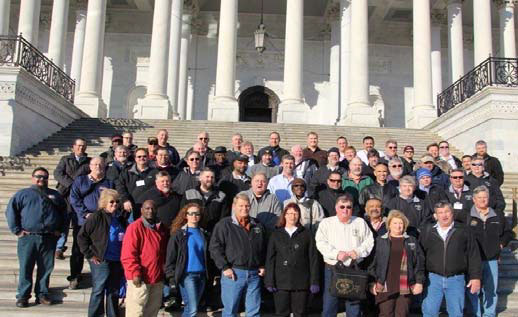
The Pulp & Paperworkers’ Resource Council (PPRC) is a grassroots organization of hourly employees in the forest products industry who educate on issues that affect American manufacturing jobs in their industry. During their three days of meetings, 73 PPRC members made 544 legislative and administration visits, including the office of the Vice President.

“Communities around the country need the types of good-paying jobs that forest products manufacturing provides, whether it’s making paper, building products, bath tissue or boxes – products Americans use every day,” said David Wise, PPRC chairman. “The PPRC believes that our elected and government officials need to protect the environment while at the same time support the global competitiveness of the U.S. forest products industry. Overly burdensome regulations and legislation ultimately hurt the U.S. workers we represent, our families, friends and neighbors that live in our communities.”

PPRC members from across the U.S. discussed several issues, including:

  • Regulatory reform. The regulatory system is a drag on our economy, job creation and the ability of the U.S. industry to compete globally. The PPRC seeks a more balanced and economical approach that does more good than harm, is based on sound science, and is transparent and accountable to the public.
  • The carbon neutrality of biomass and manufacturing byproducts. The carbon neutrality of biomass harvested from sustainably managed forests has been recognized repeatedly by agencies and institutions around the world. Forest products industry manufacturers use biomass residuals to power their facilities, reducing fossil fuel use and providing significant carbon reduction benefits to the environment. The PPRC urges policymakers to formally recognize the industry’s use of biomass for energy as carbon neutral.
  • Endangered species. Forest products industry employees support Endangered Species Act (ESA) reform. The ESA needs to be modernized and updated after 30 years.
  • Fish consumption (human health water quality criteria [HHWQC]). At a national and state level, the EPA has been imposing policies based on unrealistic assumptions that will make HHWQC more stringent, resulting in more waters being listed as impaired and creating extremely costly, unattainable permit limits for manufacturers.
  • Preserving paper options for consumers. The PPRC supports policies that recognize paper-based communications are critically important for millions of Americans. The move to digitize all forms of communication creates a disadvantage for American households without internet access and the 45 percent of seniors who do not own a computer. Increasingly, citizens are being denied the option to receive federal services and communications in paper format.

In addition, PPRC members thanked senators and members of Congress who have joined the Paper and Packaging Caucus, while requesting others join the Caucus.

The U.S. forest products industry is vitally important to our nation’s economy, employing about 900,000 people – many in small, rural communities. It ranks among the top 10 manufacturers in 45 states and represents four percent of U.S. manufacturing GDP. The PPRC is dedicated to conserving the environment while taking into account the economic stability of American manufacturing workers and their mills’ surrounding communities.

Media Contact: David Wise, PPRC Chairman; (843) 269-0164, (843) 319-7189

Vinnie Geiser

September 26, 2016

Concerned about global temperatures, Washington is phasing out electricity generated from coal – once the mainstay of, among many other applications, US Navy ship propulsion. Renewables such as wind, solar and, for Virginia especially, forest biomass (wood and byproducts derived from sustainable forest management and from paper and wood products manufacturing facilities) are favored alternatives. But now a policy impasse in Washington risks making forest-sourced biomass an energy outcast, too. Only Congress can break the bureaucratic gridlock.

At issue is a rulemaking in 2010 that suddenly and without public notice or proper scientific review reversed federal policy and regulated forest biomass the same as fossil fuels. Because of this radical departure and demands to modify the rule, the government put the rule on hold to study the science. Today—six years later and without a clear path forward—uncertainty remains for energy producers, forest owners and manufacturers that rely on forest biomass for energy. Building new facilities, retrofitting existing ones, and installing necessary emission control technologies dedicated to the fuel requires significant planning and investment. Washington’s policy paralysis has thrown an economic and environmental disincentive in the way of that essential investment.

The problem, the regulators say, is measuring the carbon impacts from forest biomass. However, the carbon benefits of woody biomass are well established, as 100 leading forestry scientists from around the U.S. have repeatedly stated in letters to the government. Those scientists cite the most comprehensive survey of peer-reviewed literature in their field concluding that, “[D]emand for wood helps keep land in forest and incentivizes investments in new and more productive forests, all of which have significant carbon benefits.”

In the U.S, the strong markets for wood products including biomass are why the volume of trees in our forests has increase 50% since the 1950s. In Virginia, despite massive post-World War II suburbanization, our state has nearly a million more acres in forestland than it did in 1940 and forest-dependent industries like logging, wood products, and pulp & paper employ over 27,000 workers. Today, our total U.S. forests offset 13 percent of total CO2 emissions annually. Those offsets are precisely why the Fourth Assessment Report of the Intergovernmental Panel on Climate Change stated, “In the long term, a sustainable forest management strategy aimed at maintaining or increasing forest carbon stocks, while producing an annual sustained yield of timber, fiber or energy from the forest, will generate the largest sustained [carbon] mitigation benefit.”

Washington’s indecision also may put U.S. policy at odds with the Paris Agreement on climate change, adopted last December. That global agreement underlines the importance of “positive incentives for … sustainable management of forests and enhancement of forest carbon stock.” It urges signers to “take action to implement and support” expansion of the global volume of trees.

Congress is working on solutions, but can it act before it adjourns? A Senate-passed energy bill provides a policy establishing the carbon benefits of forest biomass, and the Senate Interior Appropriations bill includes specific guidance on how to get that done. One way or the other, it is essential for Congress to put the US back in line with the global norm and affirm the carbon benefits of forest biomass.

Tens of thousands of Virginia jobs with manufacturing-level wages and the quality of our global environment are at stake. The international community continues to recognize that forest biomass energy is essential to a scientifically sustainable climate policy. It is time the United States did the same — again.

PPRC Members Making a Difference on Capitol Hill

February 16, 2015

Members of the Pulp & Paperworkers’ Resource Council (PPRC) visited Washington, D.C. the week of February 9, 2015 to meet with members of Congress and administration officials. Their goal was to educate elected and appointed officials and staffers on the impact of legislative decisions both on the environment and on the families and communities that depend on forest products manufacturing for their livelihood.

The PPRC is a grassroots organization of hourly employees of the forest products industry who educate on issues that impact jobs in their industry. More than 70 PPRC members from across the U.S. were in Washington last week to discuss several issues including the carbon neutrality of biomass and manufacturing byproducts, clean water, the regulatory burden impacting American manufacturing, endangered species, renewable energy, greenhouse gas regulations, truck weight reform and ensuring the competitiveness of the U.S. forest products industry.

Domtar sent four Union representatives: Joni Filipiak and Dave Tackes from Rothschild and Sam Borrello and Dane Condino from the Johnsonburg Mill. They met with the Domtar V.P. of Government affairs Thomas Howard, and Maria Brennan the Domtar V.P. for Supply Chain, who provided support and general knowledge on some of the issues being discussed.

Domtar representatives in Washington DC

Joni Filipiak provided the following report:

The 2015 PPRC group totaled 72, including the executive board. 66 of the members hit the Hill, making 404 legislative and administration meetings in 3 days. The remaining 7 members were meeting with regulatory agencies, meeting with the speaker of the House, Dept of DOT, The Vice President, Speaker of the House, EPA, CEQ, OMB, Senate Minority Whip Durbin, House Majority Leader Cornyn, U.S. Fish and Wildlife, and the Forest Service among others.

2015 PPRC Group at the Capitol

Issues this year were Carbon neutrality of Biomass and Greenhouse Gas regulations, Clean Water, Cumulative Regulatory Burden, Endangered Spieces Act and Truck Weights.

We met with the Domtar V.P. of Government affairs Thomas Howard, and Maria Brennan the Domtar V.P. for Supply Chain. Tom shared information on these topics and how it impacted Domtar as a whole. He got us the information before we left for D.C. so we were well prepared on the issues and understood how important these issues were for our Company.

LOAD LIMITS: Allowing an increase in Load limits on the roads alone could reduce the number of trucks used for shipping by 33%. That is a major savings in shipping costs for the company. In Wisconsin alone it would mean 2,816 less trucks on the road hauling product to our customers. Current road limits are 80,000#. The bill being sought would increase the limits to 97,000#. The trailers would be required to have a 6th axle which would help spread the weight, thus providing that the heavier vehicle does not increase pavement consumption. This 6th axle also gives the driver better braking for the load. This would mean 17% more ton‐miles per gallon. The U.S. DOT estimates that 6 axle rigs would save 2 billion gallons of diesel fuel annually and cut emissions by 19% per ton mile. The overall length of the rig/trailer would not increase, just the 6th axle at the back of the trailer.

ENDANGERED SPECIES: This involves the Northern Long Eared Bat. These little guys roam 39 states and are dying in some of those states due to a fungus called White Nose Syndrome (WNS). Wisconsin is among the 39 states. Activists are trying to prohibit logging in the woods within a 5 mile radius of the bat caves. The restrictions would mean NO tree cutting from April to October. They roost in the trees but not the same trees studies show, but activists are going overboard and saying NO cutting just like the Spotted Owl issue on the west coast years ago. The University of Wisconsin Madison is working on a spray to cure the White Nose Syndrome which would be used in the caves to stop the fungus and help the bat survive.

ADDITIONAL REGULATORY BURDEN – CLEAN AIR ACT: New regulations could cost billions per year and place thousands of jobs at risk and could be the costliest regulation in history. Boiler MACT still isn’t completed, and now new regulations are being implemented by the EPA. Pollutant limits today are 75 ppb in nonattainment areas. The new regulations may lower it to 60 ppb causing existing plants to install additional expensive equipment.

We were joined by 2 workers from the Johnsonburg mill, Dane Condino and Sam Borrello. This was their 1st trip to D.C. but with the information from Tom Howard they caught on fast and contributed as if they had been presenting the issues for years. They can’t wait until next year. We felt well informed on the issues and how they affected our jobs and the jobs of all of Domtar. This was by far the best support shown by the Company having us prepared to hit the issues head on in the meetings.

Long days and a lot of miles walked, but the regular workers hitting the Hill instead of the Lobbyists opens the elected officials eyes and ears to the issues because they have actual people who work in the mills that have to deal with the issues 1st hand.

Next year the PPRC will be celebrating their 25 year anniversary. As the group ages and workers retire, we say goodbye to old friends, but welcome new members who have a desire to help keep their Companies open and save their jobs. The 4 of us are proud to be a part of such a well‐respected organization on the Hill.”

  • « Previous Page
  • 1
  • 2

National Administrative Positions

  • Information Technology Director
    Dan Gignac
    Ahlstrom
    USW Local 2-15
    Rhinelander, WI 54501
    Daniel.gignac@ahlstrom.com
  • Internal Communication Director
    Lloyd Allen, USW Local 9-983
    Clearwater Paper Company
    Augusta, GA 30906
    James.Allen@clearwaterpaper.com
  • External Communication Director
    Austin Wise, USW Local 1879
    Smurfit Westrock
    Florence, SC 29505
    Awise88@me.com
  • Scheduling Director
    William Schwalbach, USW Local 2-20
    Ahlstrom
    Kaukauna, WI 54130
    Pulpandpaperworkers@gmail.com

National Special Projects Coordinators at Large

  • Chris Rice, NSC Recording Secretary
    AWPPW Local 675
    Smurfit WestRock Company
    Covington, VA 24426
    christopher.rice@smurfitwestrock.com
  • Scott Goins, IAM Local Lodge 1098
    Georgia Pacific
    Palatka, FL 32177
    scott.goins@gapac.com
  • Matt Hall, NSC Chairman IBEW Local 464 
    Smurfit WestRock Company
    Covington, VA 24426
    matt.hall@smurfitwestrock.com 
  • Jason Etheridge, NSC Vice Chairman USW Local 9-0425
    Smurfit WestRock Company
    Roanoke Rapids, NC 27870
    jasonetheridge78@yahoo.com

Executive Team

  • Clay Duke, Executive Director
    cduke@suzanopackaging.com | Pine Bluff, AR
  • Matt Hall, Chairman
    matt.hall@smurfitwestrock.com | Covington, VA
  • Jason Etheridge, Vice Chairman
    jasonetheridge78@yahoo.com | Roanoke Rapids, NC

© 2026 PPRC All Rights Reserved

SLOT777 : Link Slot Thailand Gacor Gampang Maxwin X1000

Copyright © 2026 · PPRC On Genesis Framework · WordPress · Log in